
Written by Charles N. Internicola, Esq.
Founder, The Internicola Law Firm | Franchise Attorney | Chambers USA Recognized | Ranked #1 Franchise Law Firm in the U.S. by Entrepreneur Magazine (2025)
Last Updated: July 2026
Is your business successful? Are you considering opening new locations and expanding your brand through franchising?
Franchising is one of the most effective ways to grow a proven business. Most businesses can complete the franchise development process within approximately 90 to 120 days, depending on trademark registration, Franchise Disclosure Document (FDD) preparation, operations manual development, state registration requirements, and overall franchise readiness.
This guide provides a practical roadmap for franchising your business. If you are looking for a more comprehensive resource on franchise laws, franchise costs, franchise sales strategies, and long-term franchise growth, visit our Ultimate Guide to Franchising Your Business.
The 7-Step Franchise Roadmap™ was developed by Charles N. Internicola, Esq. and The Internicola Law Firm based on twenty-five years of helping founders build franchise systems.
Quick Overview: How to Franchise Your Business
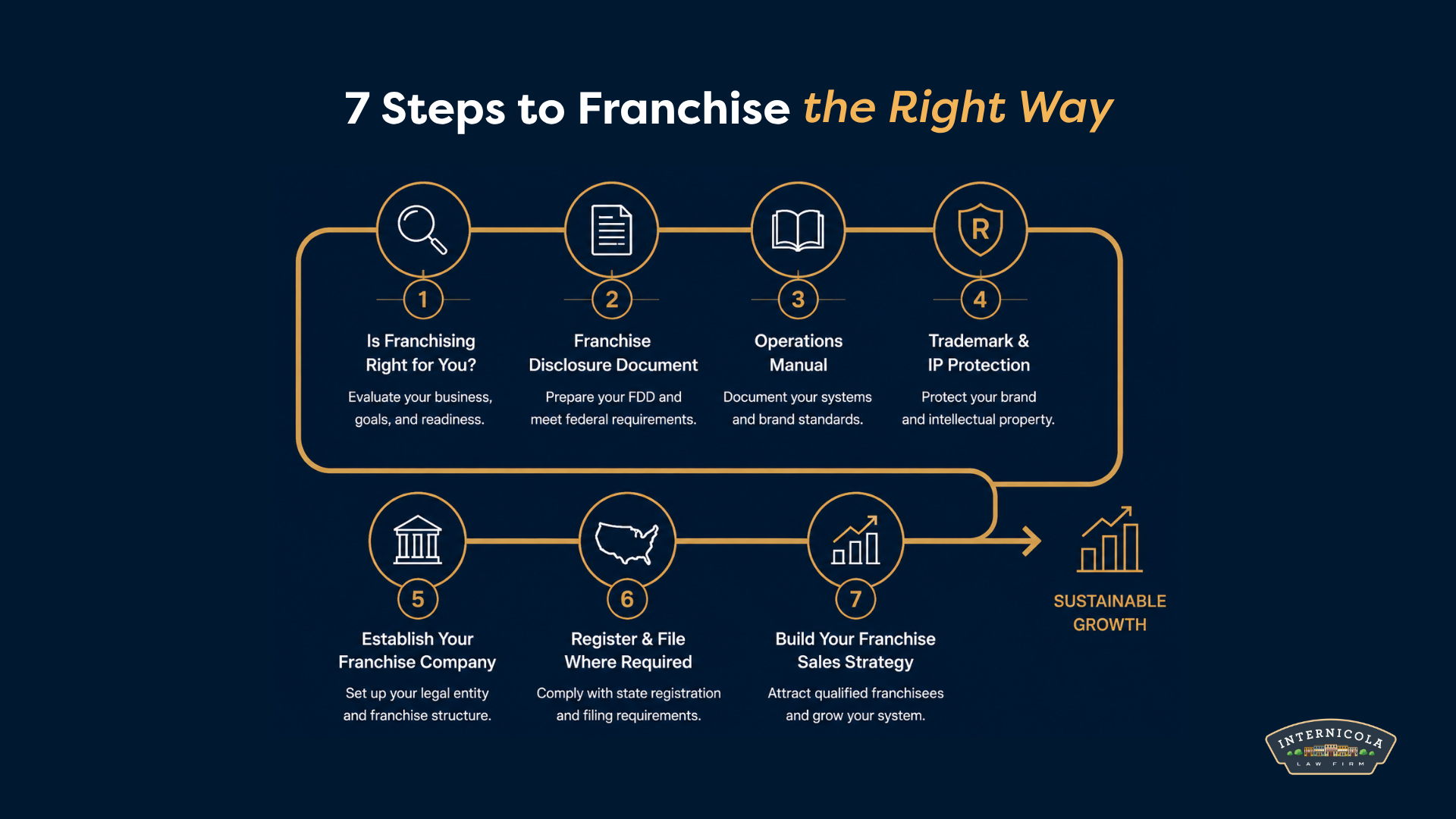
To franchise your business, follow these seven steps:
| The 7-Step Franchise Roadmap™ — Charles N. Internicola, Esq., The Internicola Law Firm | ||
|---|---|---|
| Step | What Happens | Timing |
| 1. Determine if franchising is right for your business | Industry, unit economics, capital, and founder-goals assessment | Before anything else |
| 2. Issue your Franchise Disclosure Document (FDD) | Your franchise attorney prepares the FDD and franchise agreement | Steps 2–7: 90–120 days total |
| 3. Prepare your operations manual | The confidential how-to guide for your franchise system, built by a specialist | In parallel with legal development |
| 4. Register your trademarks | USPTO federal registration protecting the brand you'll license | In parallel with legal development |
| 5. Establish your franchise company | Separate entity; a clean financial history simplifies audited statements | In parallel with legal development |
| 6. Register and file your FDD in required states | The 13 registration states plus filing states | Registration states add 60–120 days |
| 7. Create your franchise sales strategy and budget | Unit economics and franchisee validation sell franchises | Final step before launch |
What is Franchising?
Franchising is a legal and business model that allows you, as the franchisor, to expand your business by granting independent owners (franchisees) the right to open and operate locations using your trademarks, business systems, training programs, and operational support.
In exchange for franchise fees and ongoing royalties, franchisees receive the right to operate under your brand and replicate your business model.
Because franchising is regulated by federal and state franchise laws, franchisors must prepare legal disclosure documents, comply with registration requirements, and establish systems for supporting franchisees.
Step 1: Determine Whether Franchising is Right for Your Business
Before investing in franchise development, determine whether franchising is the right growth strategy for your business and whether now is the right time to pursue it.
Many business owners begin by asking whether their business can be franchised. In reality, most businesses can be franchised. The more important questions are whether franchising aligns with your goals as a founder, whether your business is prepared for franchise expansion, and whether you are ready for the responsibilities that come with supporting franchisees and operating a franchise system.
As part of that evaluation, consider:
- Whether your business model generates the profitability and unit economics necessary to support franchisees
- Whether your systems and operations can be duplicated by franchisees while maintaining brand standards
- The market demand and growth potential for your products or services
- The strength of your brand and the protectability of your trademarks
- Your capacity to train, support, and lead franchisees
- Whether franchising aligns with your personal, financial, and long-term business goals
Determining whether franchising is right for your business is often the most important step in the franchise development process.
The franchising process has unique considerations depending on your industry. If you are franchising a restaurant or food service concept, see our complete guide to How to Franchise a Restaurant. If you are franchising a mobile or home service business, see How to Franchise a Service Business.
Step 2: Prepare Your Franchise Disclosure Document (FDD)
The Franchise Disclosure Document (FDD) is the legal foundation of your franchise offering. Federal franchise laws require franchisors to provide prospective franchisees with an FDD before offering or selling a franchise.
The FDD contains detailed legal, financial, and franchise investment related information, including:
- Franchise fees
- Startup costs
- Franchisee obligations
- Territory rights
- Trademarks
- Litigation history
- Financial performance representations (Item 19)
- The franchisor's management team and business background
The FDD should be carefully prepared by an experienced franchise attorney and designed to support both compliance and long-term franchise growth.
Step 3: Develop Your Franchise Operations Manual
Your franchise operations manual is the how-to guide for your franchise system and one of the primary tools used to communicate system standards to franchisees.
The operations manual helps franchisees learn, operate, and grow within your franchise system while providing the systems, procedures, and standards necessary to replicate your business model and maintain brand standards across locations.
Operations manuals often include:
- Brand standards
- Training requirements
- Operating procedures
- Technology systems
- Vendor requirements
- Marketing standards
- Customer service expectations
- Performance benchmarks
As your franchise system grows, your operations manual will evolve alongside it, helping maintain consistency while supporting franchisee development and system growth.
Step 4: Protect Your Trademarks and Intellectual Property
Trademarks and intellectual property are among the most important assets within a franchise system. Franchisees invest in the right to operate under your brand, trademarks, systems, and intellectual property. Protecting those assets supports brand consistency, competitive differentiation, consumer trust, and long-term franchise growth.
Before franchising, business owners should evaluate:
- Trademark availability
- Existing trademark registrations
- Brand protection strategies
- Proprietary systems and processes
- Intellectual property risks
Because your franchisees will operate under your trademarks, trademark strategy should be addressed early in the franchise development process. If your trademarks cannot be protected, it may impact your ability to expand the brand and, in some situations, require changes to your branding strategy.
For this reason, many franchisors conduct trademark searches and pursue federal trademark registration through the United States Patent and Trademark Office (USPTO) before launching a franchise system. Federal registration helps protect your trademark rights nationwide and strengthens the intellectual property foundation of your franchise system.
Step 5: Establish Your Franchise Company
As part of the franchising process, you will create a separate franchise company that will serve as the franchisor.
While your existing business continues serving customers, your franchise company will be responsible for offering and selling franchises, supporting franchisees, protecting the brand, maintaining system standards, and growing the franchise system.
Your franchise company will generate revenue through franchise fees, royalties, and other franchise-related activities and will become the organization responsible for supporting franchisees and developing the franchise system.
Creating a dedicated franchise company is an important part of building the legal, financial, and operational foundation of your franchise system.
Step 6: Register and File Your FDD Where Required
In addition to complying with federal franchise laws, franchisors must also comply with state-specific franchise registration and filing requirements.
One common misconception is that Franchise Disclosure Documents (FDDs) are registered with the federal government / FTC. They are not. Franchise registration occurs at the state level, and certain states require franchisors to obtain registration approval before franchises can be offered or sold.
Depending on the state, franchisors may need to:
- Register their FDD
- Submit state filings
- Obtain registration approval
- Renew registrations annually
- Prepare state-specific addenda
Understanding state registration requirements is critical to maintaining compliance, avoiding registration delays, and ensuring that franchise sales activities can move forward without interruption.
To learn more about state-specific franchise laws, including FDD registration and filing requirements, check out our interactive franchise registration map.
Step 7: Build Your Franchise Sales Strategy
Once your franchise system is established, the next step is building a franchise sales strategy.
This often includes:
- A franchise recruitment website
- Franchise marketing materials
- Candidate qualification processes
- Discovery and validation procedures
- Franchise sales compliance systems
- Franchisee onboarding processes
Many new franchisors assume that franchise growth begins with selling as many franchises as possible. In reality, the strongest franchise systems often spend their early years seasoning their franchise offering and building a foundation for long-term growth.
For many emerging franchisors, the most effective initial sales strategy is to focus on qualified and aligned individuals who already know the brand, know the founders, are customers of the business, or otherwise have a meaningful connection to the concept.
During the first several years, the goal is not simply selling franchises. The goal is building successful franchisees, strengthening operations, improving unit economics, and generating meaningful franchisee validation.
Strong unit economics and franchisee validation remain among the most important drivers of long-term franchise growth. By focusing on the success of your first franchisees, you create the foundation for future franchise sales and sustainable expansion.
Who Does What When You Franchise Your Business
One of the most common mistakes in franchise development is assigning the wrong professional to the wrong step. Here is how responsibility breaks down across the 7-Step Franchise Roadmap™:
- FDD and franchise agreement drafting — a licensed franchise attorney, independently retained by you. Non-lawyers who prepare these documents are engaging in the unauthorized practice of law.
- Trademark clearance and USPTO registration — your franchise attorney, addressed early in the process because your entire franchise system licenses your brand.
- Franchise entity formation — your legal team, structured to shield your existing operating business and simplify the financial statement requirements under FDD Item 21.
- State registrations and filings — your franchise attorney, handled on a multi-state basis from the start so registration timing never blocks a franchise sale.
- Operations manual — you as the founder, working with a specialist operations manual writer. This is a business document, not a legal one — and it is the one area of franchise development where outside specialists genuinely add value.
- Franchise sales and marketing — your internal team, franchise brokers, or a sales organization, engaged after your legal infrastructure is complete and you have real franchisee data to inform your strategy.
How Long Does It Take to Franchise a Business?
Most businesses can complete franchise development within approximately 90 to 120 days.
The timeline often depends on:
- Trademark status and intellectual property considerations
- Franchise Disclosure Document (FDD) preparation
- Operations manual development
- Financial statement preparation
- State registration requirement
- Industry-specific regulatory and operational requirements
While franchise development can often be completed within several months, registration timelines and regulatory approvals may affect when franchises can ultimately be offered or sold.
How Much Does It Cost to Franchise a Business?
The cost to franchise a business typically ranges from approximately $46,000 to $100,000 or more depending on:
- Legal services and franchise development support
- Trademark registration and intellectual property work
- Operations manual development
- Financial statement preparation
- State registration and filing requirements
- Franchise sales and marketing objectives
- The overall complexity of the franchise system being developed
For a more detailed breakdown, see our guide on the cost to franchise a business.
Frequently Asked Questions
Most businesses can be franchised. The more important questions are whether franchising is the right growth strategy for your business, whether now is the right time to franchise, and whether you are prepared for the responsibilities associated with supporting franchisees and operating a franchise system.
There is no universal profitability requirement to franchise a business. However, business owners should evaluate whether their business model generates the unit economics, profitability, and operational consistency necessary to support successful franchisees. Strong franchise systems are often built on proven economics that can be replicated across multiple locations and operators.
The first step is determining whether franchising aligns with your goals as a founder, whether the timing is right, and whether your business is prepared for franchise expansion.
Most businesses can complete the franchise development process within approximately 90 to 120 days. The timeline may vary depending on trademark status, FDD preparation, operations manual development, financial statements, and state registration requirements.
Yes. Franchise laws are highly regulated, and franchisors should work with an experienced franchise attorney to prepare the Franchise Disclosure Document (FDD), franchise agreements, state registrations, and related compliance documents.
Most businesses invest between approximately $46,000 to $100,000 or more depending on their legal, operational, compliance, and franchise development needs. The total investment may also vary based on trademark work, registration requirements, operations manual development, and franchise sales objectives.
Ready to Franchise Your Business?
Schedule a conversation with our team to discuss whether franchising is right for your business, what it takes to launch a franchise system, and how to build the foundation for long-term franchise growth.